In short
- For glued (dryback) PVC, manufacturers and installers usually work to a maximum of around 2 mm height difference over 2 metres.
- Click PVC is somewhat more forgiving thanks to the underlay, but large height differences remain a problem.
- Besides flatness, residual moisture matters: common guidelines are ≤ 2.0 CM% for a cement screed and ≤ 0.5 CM% for anhydrite — lower with underfloor heating.
- The manufacturer’s product data sheet always takes precedence.
Why flatness matters so much
PVC is only a few millimetres thick and, when glued, sits directly on the subfloor. Every bump, joint or bit of adhesive residue gradually shows through, especially in low light from a window. With click PVC, irregularities can stress the click joints, causing gaps or creaking.
Guidelines per floor type
| Floor type | Common flatness guideline | Levelling needed? |
|---|---|---|
| Glued (dryback) PVC | Max. approx. 2 mm over 2 metres; some installers work stricter | Almost always |
| Click PVC | Per data sheet; the underlay absorbs small irregularities | With larger height differences |
| Laminate | Per data sheet; floated on an underlay | With larger height differences |
In the Netherlands, flatness requirements for floors are set out in the NEN 2747 standard, which has several flatness classes. For a PVC floor we would rather apply too strict a standard than too loose a one.
How to measure flatness
- Place a straight 2-metre straightedge in several places and directions on the floor.
- Check whether light shows under the straightedge and measure the largest gap, for example with feeler gauges or a wedge.
- Pay extra attention to joints in the screed, transitions at doors and places where old floor covering has been.
Not sure? We measure it for you during the inspection, before we prepare a quote.
Don’t forget residual moisture
PVC hardly lets moisture through. If the screed is still too damp, the adhesive can fail or mould can develop. Residual moisture is measured with the CM (calcium carbide) method. Common guidelines:
| Screed | Without underfloor heating | With underfloor heating |
|---|---|---|
| Sand-cement screed | ≤ 2.0 CM% | ≤ 1.8 CM% |
| Anhydrite screed | ≤ 0.5 CM% | ≤ 0.3 CM% |
With underfloor heating, a heating-up protocol is often required before the floor may be laid.
Per type of subfloor
- Concrete or cement screed — levels well after sanding and priming.
- Anhydrite — needs the right primer and a dry subfloor; often sanded first to remove the top layer.
- Tiles — the joints and height differences must be filled first. Click PVC can sometimes go directly on a flat tiled floor.
- Wood — wooden floors move; a different build-up than levelling compound alone is often needed.
Not flat enough? This is how we solve it
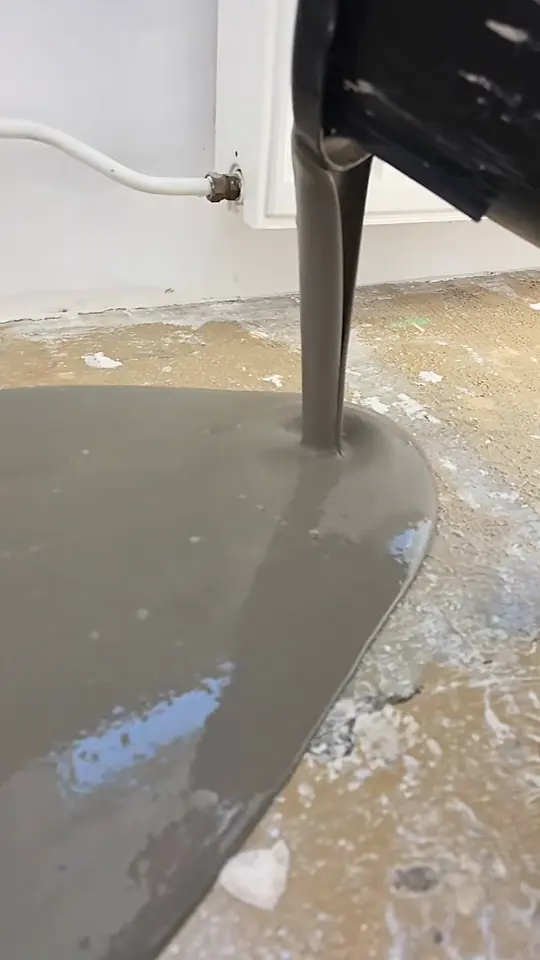
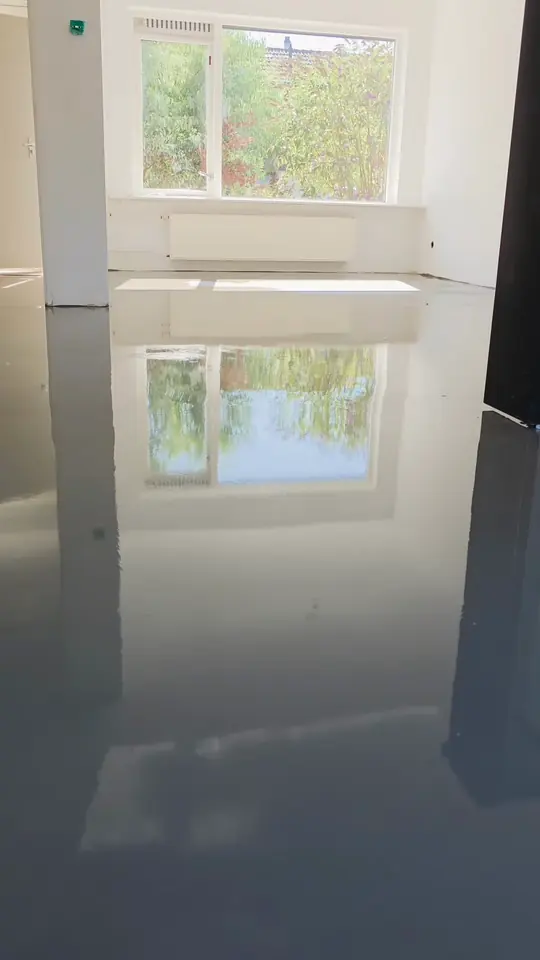
In most homes, floor levelling is the solution: after sanding and priming we apply a liquid levelling compound that flows out flat by itself. Once dry, we check the flatness again. How long drying takes is explained in Floor levelling: drying time and preparation.
Need help with your floor?
We handle the subfloor, installation and finishing — in Friesland, Groningen and Drenthe. Feel free to send a photo on WhatsApp for a first estimate.
Related services
This article gives general information and guidelines. The situation on site and the manufacturer’s instructions always take precedence.